
Printed book
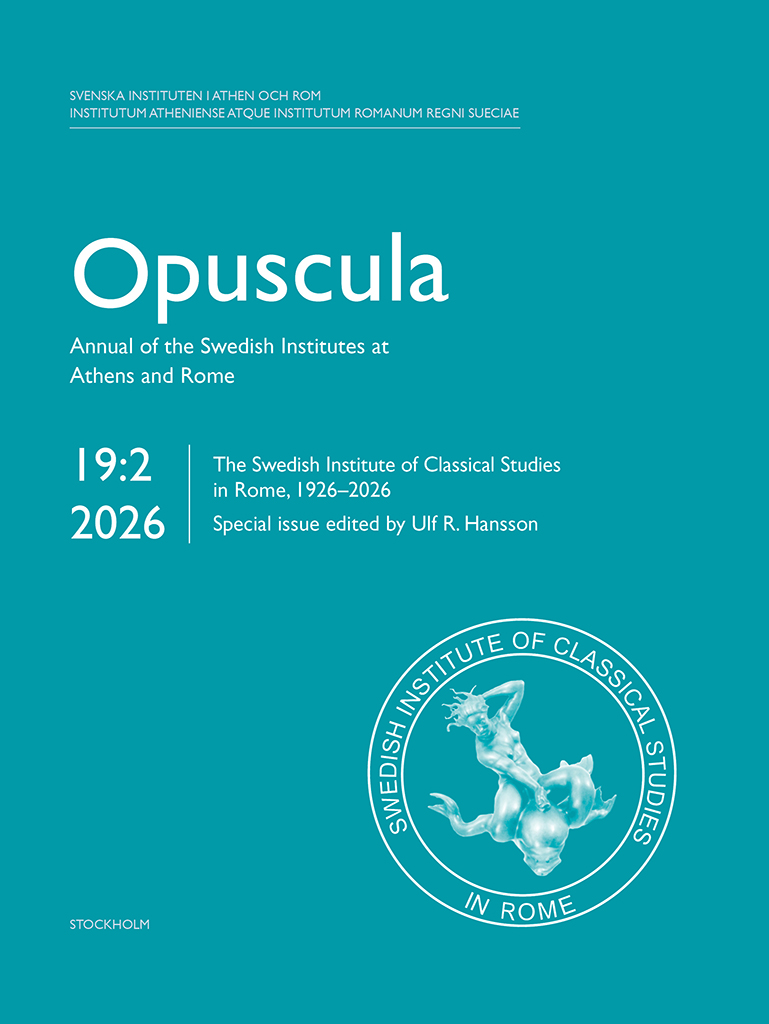


- Published 2026
- Isbn 9789197779999
- Issn 2000-0898
- Opuscula, 19:2
- Type Paperback
- 408 pages
- English
Opuscula 19:2 | 2026
The Swedish Institute of Classical Studies in Rome, 1926–2026
Special issue edited by Ulf R. Hansson
Contents
The Swedish Institute of Classical Studies in Rome, 1926–2026. One hundred years of Swedish research in and on Italy
By Ulf R. Hansson, pp. 7–8, https://doi.org/10.30549/opathrom-19-2-02
Articles
Friends, Romans, countrymen. Directors and directions of the Swedish Institute in Rome, 1926–1948
By Frederick Whitling, pp. 9–42, https://doi.org/10.30549/opathrom-19-2-03
A Swedish lad in Etruria. The Etruscological fieldwork of Olof August Danielsson
By Annie C. Burman, pp. 43–57, https://doi.org/10.30549/opathrom-19-2-04
A Bronze Age chamber tomb at Le Pampanare (Blera, Viterbo), Italy
By Francesco di Gennaro & Fredrik Tobin-Dodd, pp. 59–79, https://doi.org/10.30549/opathrom-19-2-05
The chronological phases of Etruscan San Giovenale
By Lars Karlsson, pp. 81–98, https://doi.org/10.30549/opathrom-19-2-06
Food preparation in southern interior Etruria: Milk boiling at Acquarossa
By Eva Rystedt with an appendix by Letizia Ceccarelli, pp. 99–108, https://doi.org/10.30549/opathrom-19-2-07
Weaving at Acquarossa. A set of twelve loom weights from Zone B
By Hedvig Landenius Enegren, pp. 109–126, https://doi.org/10.30549/opathrom-19-2-08
Charcoal, burnt daub and vitrified tiles. Fire hazard in ancient Central Italic settlements and towns
By Örjan Wikander, pp. 127–145, https://doi.org/10.30549/opathrom-19-2-09
A new possible cult complex from the Urban Plateau at Vulci
By Serena Sabatini, Jelena Bulatović, Anna Gustavsson, Elena Peri, Natalia Riabogina & Irene Selsvold, pp. 147–163, https://doi.org/10.30549/opathrom-19-2-10
Pastoral landscapes, transhumance and Etruria
By Barbro Santillo Frizell, pp. 165–181, https://doi.org/10.30549/opathrom-19-2-11
The Blera Archaeological Project. A preliminary report of the 2023 and 2024 field campaigns of the Swedish Institute in Rome’s field project in Blera, Province of Viterbo, Lazio
By Hampus Olsson, Giacomo Landeschi, Melda Küçükdemirci & Salvatore Piro, pp. 183–203, https://doi.org/10.30549/opathrom-19-2-12
Specular reflections of Etruscan nature
By Ingela M.B. Wiman, pp. 205–218, https://doi.org/10.30549/opathrom-19-2-13
Etruscan amphorae in the Elymian uplands. Monte Polizzo and the dynamics of Archaic trade in western Sicily
By Cecilia Sandström, pp. 219–235, https://doi.org/10.30549/opathrom-19-2-14
Francavilla di Sicilia. An overview of the site and recent fieldwork
By Kristian Göransson, pp. 237–246, https://doi.org/10.30549/opathrom-19-2-15
Visiting the peristyle in the House of Caecilius Iucundus (V 1,22–27) in Pompeii
By Arja Karivieri & Renée Forsell, pp. 247–288, https://doi.org/10.30549/opathrom-19-2-16
A different storey. Exploring the upper floors of the double-atrium complex of Caecilius Iucundus (V 1,22–27) in Pompeii
By Danilo Marco Campanaro, Daniele Ferdani, Renée Forsell, Arja Karivieri & Anne-Marie Leander Touati, pp. 289–313, https://doi.org/10.30549/opathrom-19-2-17
Narbonne. Riverscape and port network
By Madelaine Miller, pp. 315–323, https://doi.org/10.30549/opathrom-19-2-18
Exploring our common past. The Late Roman solidi of Italy and Scandinavia
By Svante Fischer, pp. 325–340, https://doi.org/10.30549/opathrom-19-2-19
Gino Filipetto e l’iscrizione latina CIL VI 23257
By Astrid Capoferro, pp. 341–346, https://doi.org/10.30549/opathrom-19-2-20
Vulgarization and normalization in medieval manuscript traditions
By Gerd V.M. Haverling, pp. 347–356, https://doi.org/10.30549/opathrom-19-2-21
Material matters. Painting, marble, conservation
By Agneta Freccero, pp. 357–370, https://doi.org/10.30549/opathrom-19-2-22
The commemoration of foreign artists in the Protestant Cemetery at Rome, 1750–1970. With a new inventory of their graves
By Nicholas Stanley-Price, pp. 371–403, https://doi.org/10.30549/opathrom-19-2-23